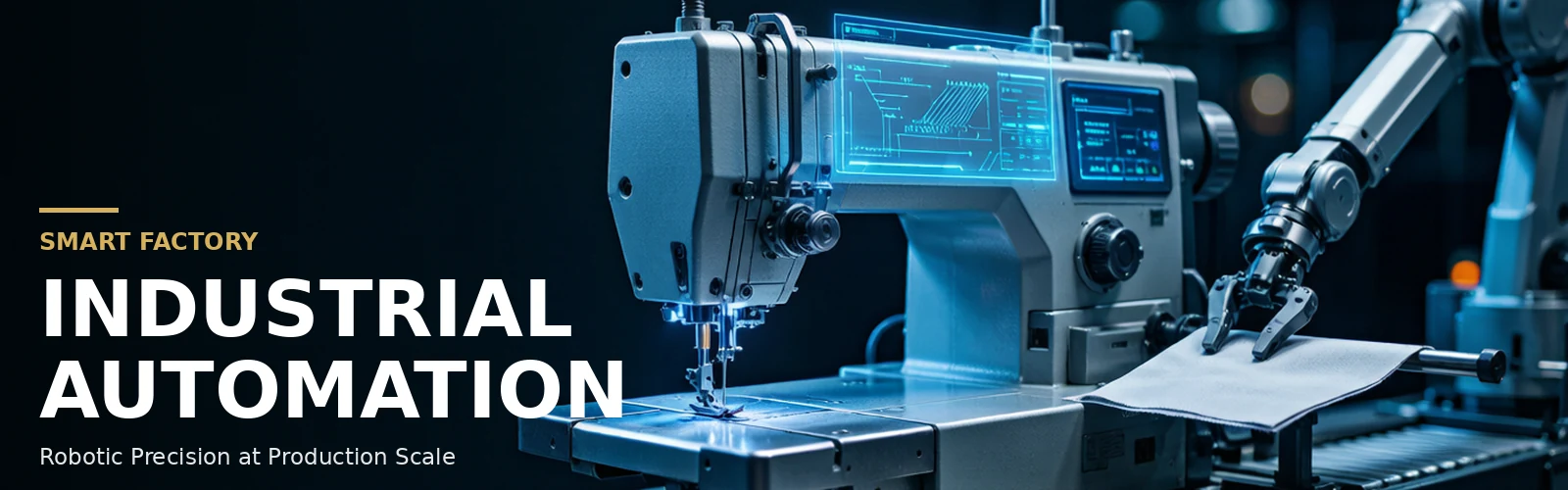




Automated Sewing Machines in Garment Factories: A Technical Solution for 300% Efficiency Improvement
Automated Sewing Machines in Garment Factories: A Technical Solution for 300% Efficiency Improvement
For garment factories producing denim jackets, jeans, and heavy-duty workwear, the gap between a profitable operation and a struggling one often comes down to a single metric: efficiency. Labor costs are rising, skilled operators are increasingly difficult to find, and buyers demand faster turnaround times at higher quality standards. The factories that thrive are those that embrace automation—not as a distant future, but as a present-day competitive necessity.
This guide examines how automated sewing machines work, provides a practical ROI calculation model, presents real-world case study data from garment factories, and outlines a phased upgrade roadmap from semi-automatic to fully automatic production.
1. What Is an Automated Sewing Machine and How Does It Differ from a Standard Machine?
An automated sewing machine is a programmable system that executes complete stitching operations with minimal operator intervention. Unlike standard industrial machines that require an operator to guide fabric through every stitch, automated machines use CNC (Computer Numerical Control) systems to control fabric movement in X and Y axes while the sewing head operates independently.
Key architectural differences:
| Feature | Standard Industrial Machine | Automated Sewing Machine |
|---|---|---|
| Fabric Control | Manual guidance by operator | Programmable X-Y table or robotic arm |
| Pattern Storage | None | Stores multiple programs (USB/SD/cloud) |
| Operator Role | Active throughout sewing cycle | Loading/unloading, monitoring |
| Stitch Consistency | Dependent on operator skill | Program-controlled, repeatable |
| Changeover Time | Manual adjustment required | Template swap or program selection |
The core principle: automated machines separate fabric setting from sewing processing. As JUKI explains, template sewing "frees up the workforce manning a line by separating the operations of 'fabric setting' and 'sewing processing.' The machine no longer requires an operator constantly stationed by its side as it runs."
2. How Do Automated Sewing Systems Work? The Technology Stack Explained
A complete automated sewing system integrates four technology layers:
Layer 1: CNC Control System
The machine's central computer processes stitch pattern data and sends motion commands to the X-Y table (or robotic arm) and the sewing head. Modern systems support touch-screen programming, USB/SD storage, and the ability to import DXF or PLT files directly from garment CAD software.
Layer 2: Precision Motion Control
Direct-drive servo motors and stepper motors provide the mechanical movement. The stepper motor controls the presser foot lift and needle positioning, while servo motors drive the X-Y table movement. This dual-motor architecture ensures quiet, precise operation with minimal maintenance.
Layer 3: Smart Fixtures and Templates
The template or jig holds the fabric in the correct position and guides the stitching path. Pneumatic clamping mechanisms secure the fabric during sewing. Templates can be swapped quickly for different garment styles, enabling flexible production.
Layer 4: Quality Monitoring
Modern automated machines include thread breakage detection, fabric edge sensors, and real-time stitch quality monitoring. Some systems use AI-powered vision to detect defects and automatically adjust parameters.
Technical specification example: The GT-8040-HL programmable pattern sewing machine features a 400×800mm sewing area, direct-drive servo motors, touch-screen programming, USB/SD storage, automatic thread trimming, and pneumatic presser foot lift. It supports storage of multiple programs for standardized production.
3. What Efficiency Gains Can Automated Machines Deliver?
The productivity improvement from automation is substantial and measurable:
| Machine Type | Productivity Gain | Labor Reduction | Defect Rate | Payback Period |
|---|---|---|---|---|
| Large-format programmable (GT-8040) | 200–300% | 50–70% | <1% | 6–12 months |
| Large-format programmable (GT-10060) | 200–350% | 60–80% | <1% | 6–10 months |
| Small-format CNC (GT-3520) | 200–500% | 40–60% | <70% reduction | 6–10 months |
| Small-format pattern (GT-1906) | 200–400% | 30–50% | <70% reduction | 6–12 months |
Real-world production data: A controlled study of a Juki AMS-221EN/2516 programmable sewing machine with a semi-automatic jig-fixture-template system for pocket attachment showed:
-
Cycle time reduced from 11.9±0.7 seconds to 8.3±0.5 seconds per part (−30.3%)
-
Output increased from 1,212 to 1,739 parts per 4 hours (+43.5%)
-
Stitch quality became "more stable and less dependent on operator skill" due to elimination of manual edge holding
AI-enhanced sewing systems demonstrate even greater gains: training time reduced by 60%, operator efficiency improved by 8–15%, and overall line efficiency improvement of 5–10% through bottleneck identification and AI-assisted parameters.
4. What Is the ROI Calculation Model for an Automated Sewing Machine?
Total return on investment for an automated sewing machine must account for all cost savings and productivity gains. The comprehensive formula is:
Annual Net Gain = Labor Savings + Productivity Profit + Quality Loss Savings − Annual Maintenance & Consumables
Breakdown of each component:
| Component | Calculation Method | Example (Medium Factory) |
|---|---|---|
| Labor Savings | (Workers replaced × Monthly Salary) × 12 | 6 workers × $600/month × 12 = $43,200 |
| Productivity Profit | Additional Daily Output × Profit per Unit × Working Days | 5,000 units × $0.12 × 300 days = $180,000 |
| Quality Loss Savings | (Manual Defect Rate − Automated Defect Rate) × Annual Output × Cost per Defect | (8% − 1.5%) × 1M units × $0.30 = $19,500 |
| Annual Maintenance | Equipment Total Price × 5%/year | $50,000 × 5% = $2,500 |
Typical ROI inputs for a medium-scale T-shirt production line:
| Cost Category | Traditional Manual Line | Automated Line |
|---|---|---|
| Annual Labor Cost | 25 workers × $600/month × 12 = $180,000 | 8 workers × $600/month × 12 = $57,600 |
| Annual Defect-Related Loss | 10% defect rate × 1M units × $0.30 = $30,000 | 1.5% defect rate × 1M units × $0.30 = $4,500 |
| Annual Maintenance | $5,000 | $12,500 |
Annual Savings Calculation: Labor savings ($122,400) + Quality savings ($25,500) − Additional maintenance ($7,500) = **$140,400 annual net gain**
For a medium-scale automated line with equipment investment of $80,000–$150,000, payback period is 7–13 months, with continued savings thereafter.
Industry benchmark: A garment factory adopting automated equipment reported that "each production line saves over $20,000 in production costs annually" while also reducing defects from operator errors.
5. What Real-World Case Studies Demonstrate the Impact?
Case Study 1: Trousers Waistband Automation (Yiwu, China)
A Chinese garment factory implemented automatic waistband elastic splicing equipment. Results:
-
1 hour: 1,000 waistband elastic units completed
-
Accuracy: Error margin under 1mm
-
Comparison: Equivalent to 2 skilled operators' daily output
-
Annual savings: Over $20,000 per production line
-
Labor reduction: From 8 operators per line to 1 operator monitoring 2 machines
Case Study 2: Robotic Shirt Perimeter Stitching (Academic Research)
A vision-driven robotic system for shirt cuff, collar, and pocket-flap assembly achieved:
-
Stitch placement accuracy: Within ±1mm
-
Trajectory generation: Approximately 10 seconds per pattern
-
Edge detection F-measure: 0.8517 (improving on baseline by 4.02 percentage points)
Case Study 3: AI-Powered Sewing Machine Performance
An AI sewing machine deployed with major garment manufacturers demonstrated:
-
Training cycle reduction: 60%
-
Operator efficiency improvement: 8–15%
-
Parameter adjustment efficiency: 80% improvement
-
Execution rate improvement: Over 90%
Case Study 4: Automated Pocket Welting (Vietnam)
A semi-automatic jig-fixture-template system on a programmable sewing machine for pocket facing attachment:
-
Cycle time: Reduced from 11.9s to 8.3s per part
-
Output: Increased from 1,212 to 1,739 parts per 4 hours
-
Quality: Topstitch line became more stable and less operator-dependent
6. What Does the Automation Upgrade Roadmap Look Like?
Automation is not a single purchase—it is a phased transformation. The optimal approach follows four stages:
Phase 1: Semi-Automatic Upgrades (Months 1–12)
-
What to implement: Direct-drive servo motor retrofits, automatic thread trimmers, auto-backtack, needle positioning
-
Investment per machine: $200–$800
-
Expected gain: 15–25% efficiency improvement
-
Payback: 7 months – 2 years
Phase 2: Automated Workstations (Months 12–24)
-
What to implement: Template sewing machines for pocket setting, waistband attachment, collar/placket operations
-
Investment per machine: $5,000–$20,000
-
Expected gain: 30–50% efficiency over manual, defect rate under 1%
-
Payback: 6–12 months
Phase 3: Multi-Machine Operation (Months 18–36)
-
What to implement: One operator managing 2–3 automated machines simultaneously
-
Investment: $15,000–$50,000 per cell
-
Expected gain: 60–80% productivity improvement per operator
-
Key metric: AI systems now enable "1 person managing 20 machines" for specific operations like T-shirt hemming.
Phase 4: Fully Automated Lines (Months 24–48)
-
What to implement: Integrated automated cells with robotic material handling
-
Investment: $100,000+ per line
-
Expected gain: 100%+ productivity improvement
-
Data integration: Real-time IoT monitoring, predictive maintenance, digital production management
7. What Are the Key Machine Types for Denim and Heavy Fabric Production?
For factories producing denim jackets, jeans, and heavy workwear, the automation portfolio should include:
| Machine Type | Application | Key Specification |
|---|---|---|
| Large-format programmable sewing machine | Back pockets, large decorative patterns | 400×800mm or larger, 200–300% productivity gain |
| Small-format CNC pattern machine | Belt loops, labels, velcro, small components | 50×60mm to 350×200mm, 200–500% gain |
| Template sewing machine | Pocket setting, waistband, complex curves | Pre-programmed templates, <1% defect rate |
| Automatic pocket welting machine | Suit and jacket pockets | Fully automatic folding, positioning, sewing |
| Automatic waistband machine | Trousers, jeans waistband | 4-needle, 8-thread configuration, 4,500 SPM |
Production example: A large-format programmable sewing machine for denim back pockets can complete the pocket attachment operation in a single automated cycle, eliminating the manual folding, positioning, and reinforcement steps that traditionally require multiple operators.
8. How Does DOIT Group Support Automation Upgrades?
DOIT Group manufactures industrial sewing machines designed for the demands of continuous production and compatible with automation system integration. With over 10 years of experience in producing and exporting garment equipment, DOIT specializes in a comprehensive range of machines including lockstitch, interlock, overlock, and special sewing machines, as well as embroidery machines.
DOIT's automation-ready machine portfolio:
| Product | Type | Automation Capability | Best For |
|---|---|---|---|
| DT 3020TD | Automatic pocket attach machine | Fully automatic folding, positioning, sewing, stacking | Jeans, workwear pocket attachment |
| DT 254 | Belt loop machine | High-speed, uniform strength | Denim belt loops |
| DT 165-02 | Placket machine | Precision flat finish | Shirt and jacket plackets |
| DT 63900 | Computerized trousers bottom hemming | Automatic trimming, folding | Jeans hemming |
| DT C10-D4 | Direct-drive computerized lockstitch with stepper motor | Stepper motor control, LCD interface, 550W motor | Precision garment construction |
Why DOIT machines support automation:
-
All-metal construction: Cast-iron frames withstand continuous production and resist vibration that degrades stitch quality
-
Direct-drive servo motors: Save over 60% power while improving production efficiency by more than 30%
-
Standard 135×17 needle systems: Easy parts sourcing and consistent operation across your fleet
-
ISO9001 quality certification: CE and ISO compliance for international standards
-
2-year warranty on motor, 1-year on machine parts: Protection for your automation investment
Industry validation: The garment industry's shift toward automation is accelerating. Global apparel manufacturers are increasingly adopting AI-powered sewing systems that combine "perception, analysis, and decision-making" into intelligent closed-loop production.
9. What Investment Planning Considerations Are Critical?
Capital allocation strategy:
-
Start with Phase 1 retrofits (lowest cost, quickest payback) to generate savings that fund Phase 2 investments
-
Prioritize high-volume operations where automation delivers the fastest ROI
-
Consolidate orders to maximize supplier negotiation leverage
Operational preparation:
-
Template engineering: JUKI emphasizes that "template engineers" are becoming core personnel—converting skilled operator expertise into systems that anyone can use
-
Training investment: AI systems reduce training cycles by 60%, but initial training on automated equipment is essential
-
Maintenance planning: Budget 5% of equipment value annually for maintenance, templates, and consumables
Financial planning:
-
Budget for ancillary costs: Installation and debugging 8–12% of equipment price, annual maintenance 5% of equipment price
-
Consider financing options: Leasing or installment plans can preserve working capital
-
Track ROI monthly: Monitor labor savings, output increases, and defect reduction to validate investment
10. The Bottom Line
Automation is no longer optional for garment factories competing in today's market. The data is clear: automated sewing machines deliver 200–300% productivity improvements, 50–70% labor reduction, defect rates under 1%, and payback periods of 6–12 months.
Key takeaways:
-
Separate fabrication from sewing: Automated systems allow operators to load templates while machines sew, multiplying productivity
-
Start with semi-automatic upgrades: Servo motors and auto-trimmers deliver immediate ROI with minimal investment
-
Scale to automated workstations: Template sewing machines for pockets, waistbands, and complex patterns deliver 30–50% efficiency gains
-
Plan for multi-machine operation: One operator managing 2–3 automated machines transforms labor productivity
-
Choose reliable equipment: DOIT Group's industrial machines provide the durability and precision needed for automation success
The factories that embrace automation systematically will capture market share through faster delivery, higher quality, and lower costs. The time to act is now.
Ready to start your automation journey? Explore DOIT Group's full range of industrial sewing machines and automation-ready equipment at denimsewing.com.
📩 Email: sales6@chinadoit.cn
🌐 Website: denimsewing.com