


Why Ergonomic Sewing Machine Tables Matter?
Why Ergonomic Sewing Machine Tables Matter
Sewing operators often work for several hours in a seated position while performing repetitive hand, arm, shoulder, and foot movements. If the worktable is too high, too low, or poorly positioned, employees may experience:
- Neck and shoulder tension
- Lower-back discomfort
- Wrist and forearm strain
- Reduced visibility of the sewing area
- Excessive foot and knee pressure
- More frequent micro-breaks
- Higher risk of sewing errors
- Slower material handling
An ergonomic table allows the operator to sit close to the needle area with relaxed shoulders, supported feet, and sufficient clearance for the knees. This improves comfort while helping maintain consistent sewing speed throughout the shift.
Ergonomic improvements do not replace proper training, job rotation, or rest breaks. However, they can make the entire workstation safer and more efficient.
Recommended Industrial Sewing Machine Worktable Dimensions
The correct dimensions depend on the sewing machine type, operator height, garment process, and whether the operator works seated or standing. The following ranges are practical starting points for factory planning.
Standard Dimensions for a Seated Sewing Workstation
| Worktable Feature | Recommended Range |
|---|---|
| Table height from floor | 680–750 mm |
| Adjustable height range | Approximately 650–800 mm |
| Table depth | 500–650 mm |
| Table width | 1,000–1,300 mm |
| Front edge radius | Minimum 2–3 mm |
| Knee clearance height | At least 600 mm |
| Knee clearance width | Approximately 500–650 mm |
| Foot-pedal distance | 100–250 mm from the operator’s natural foot position |
| Tabletop thickness | Usually 25–35 mm, depending on construction |
These dimensions should be adapted to the operator population. A fixed-height table may be acceptable when all operators are similar in height, but adjustable furniture is usually a better choice for mixed teams and multi-shift operations.
Recommended Operator Position
When the operator is correctly positioned:
- The feet should rest flat on the floor or on a footrest.
- The knees should remain at approximately 90–105 degrees.
- The elbows should stay close to the body.
- The shoulders should remain relaxed rather than lifted.
- The eyes should naturally focus on the needle and material area.
- The wrists should remain as straight as possible.
- The operator should not need to lean forward continuously.
The sewing machine head should be installed so that the needle area is visible without forcing the operator to bend the neck or rotate the torso.
Height Adjustment Solutions for Sewing Machine Tables
A height-adjustable sewing table is one of the most effective ways to improve workstation ergonomics. It allows the same workstation to accommodate different operators, machine types, and production methods.
1. Manual Telescopic Legs
Manual telescopic legs are a cost-effective option for smaller workshops and factories. The height is adjusted by loosening a locking mechanism and repositioning the leg.
Advantages:
- Low purchase and maintenance cost
- Simple mechanical construction
- No electrical connection required
- Suitable for occasional adjustment
Limitations:
- Adjustment takes longer
- Operators may not change the height frequently
- All legs must be adjusted evenly
2. Hand-Crank Adjustment
A hand-crank system uses a mechanical screw mechanism to raise or lower the table.
Advantages:
- More precise than fixed legs
- No motor or power supply needed
- Suitable for moderate adjustment frequency
- Stable under normal industrial loads
This option is useful when a factory wants flexibility without the cost of an electric lifting system.
3. Electric Height Adjustment
Electric lifting columns allow operators or supervisors to adjust table height quickly using a control switch.
Recommended features include:
- Dual lifting columns for stability
- Anti-collision protection
- Overload protection
- Lockable control buttons
- Low-noise motor operation
- Memory presets for different operators
Electric adjustment is particularly useful in factories with multiple shifts, different operator heights, or machines that require both seated and standing work.
4. Sit-Stand Sewing Workstations
Some sewing processes benefit from alternating between seated and standing positions. A sit-stand table can help reduce static loading on the lower back and legs.
A practical sit-stand setup should include:
- Adjustable machine height
- Anti-fatigue floor mat
- Height-adjustable stool
- Foot support
- Adequate cable and air-line management
- Sufficient space for material movement
Not every sewing operation is suitable for standing work. The process, machine type, fabric weight, and operator preference should be evaluated before changing the working position.
Ergonomic Design Details That Improve Comfort
Height adjustment is important, but it is only one part of an effective workstation.
Rounded Front Edge
A rounded or beveled front edge reduces pressure on the operator’s forearms. Sharp table edges can create discomfort during long sewing cycles.
Proper Knee Clearance
The underside of the table should provide enough space for the thighs and knees. Avoid placing drawers, control boxes, or structural braces where they interfere with the operator’s legs.
Adjustable Chair
The chair should offer:
- Adjustable seat height
- Stable five-point base
- Supportive backrest
- Optional lumbar support
- Easy-clean industrial upholstery
- Foot support when needed
The chair and table must be adjusted together. A perfectly designed table will not solve ergonomic problems if the seat is too low or too far from the machine.
Foot Pedal Position
The pedal should be positioned so that the operator can control it without stretching the leg or twisting the ankle. The foot should remain supported, and the pedal should not force the knee into an excessively raised position.
Lighting
Use task lighting to illuminate the needle and fabric area without creating glare. Adjustable LED lights can improve visibility, especially when working with dark denim, black thread, or detailed stitching.
Material Presentation
Frequently handled materials should be placed within the operator’s primary reach zone. Repeatedly reaching far to the side can increase shoulder fatigue and reduce cycle efficiency.
Factory Layout Planning for Industrial Sewing Lines
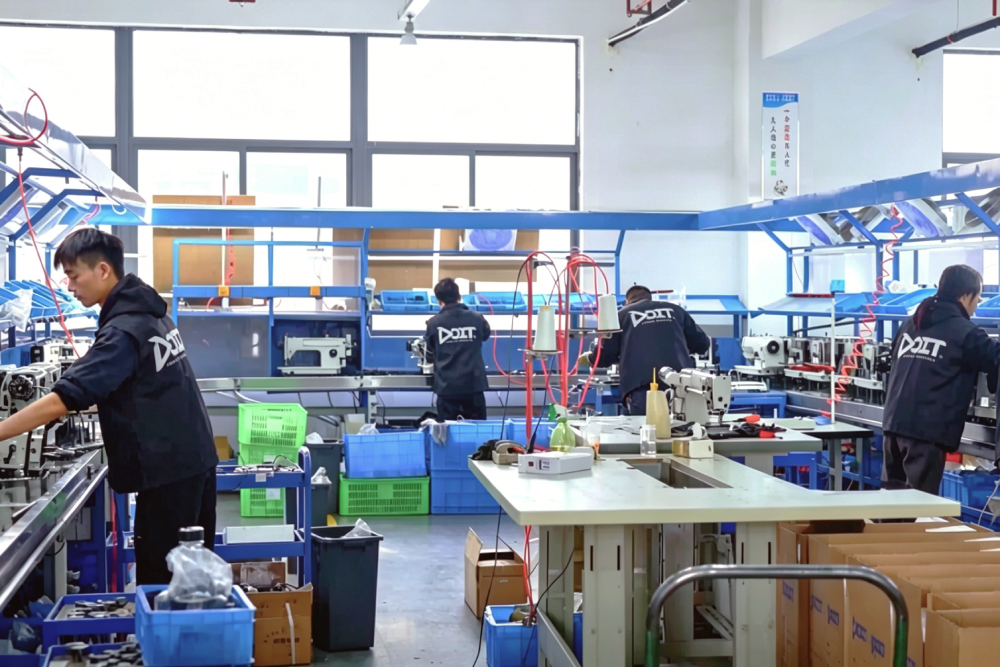
An ergonomic sewing machine table works best when it is part of a well-planned production system. The layout should minimize unnecessary walking, reaching, twisting, and material transfer.
Key Layout Principles
- Keep material flow in one direction.
- Place frequently used supplies within easy reach.
- Maintain adequate aisle width for operators and carts.
- Separate incoming bundles from completed work.
- Keep inspection points close to the relevant sewing process.
- Avoid blocking emergency exits or electrical panels.
- Provide enough space for machine maintenance.
- Reduce cross-traffic between sewing operators.
Potential Productivity Improvements
Ergonomic workstation improvements can produce measurable operational benefits, although results vary by factory, process, operator skill, and implementation quality.
Industry ergonomics programs and factory improvement projects commonly report:
- 5–15% improvement in effective output after reducing unnecessary reaching, walking, and workstation adjustment problems
- 10–25% reduction in reported discomfort when table height, chair position, lighting, and pedal placement are corrected
- Fewer quality defects when operators have better visibility and less fatigue
- Reduced setup time when height adjustment and machine controls are standardized
- Improved attendance and retention in physically demanding production environments
These figures should be treated as planning benchmarks rather than guaranteed results. A factory should measure its own performance using:
- Pieces per operator per hour
- Standard minute value performance
- Defect and rework rates
- Operator discomfort surveys
- Absenteeism and turnover
- Average walking distance per bundle
- Machine downtime and adjustment time
A four-week before-and-after trial is often enough to identify whether an ergonomic table upgrade is producing measurable benefits.
How to Implement an Ergonomic Sewing Workstation Program
Step 1: Observe the Existing Workstation
Record how operators sit, reach, bend, use the pedal, and handle materials. Ask employees where they feel discomfort and which tasks create the most fatigue.
Step 2: Measure the Operator Population
Measure or review the height range of employees. If the workforce includes a wide range of body sizes, prioritize adjustable tables and chairs.
Step 3: Adjust the Workstation
Set the table, chair, pedal, lighting, and material bins as a complete system. Avoid changing only one component.
Step 4: Test with Operators
Allow operators to use the revised workstation for several shifts. Collect feedback on comfort, visibility, machine control, and material handling.
Step 5: Track Production Data
Compare productivity, quality, fatigue reports, and downtime before and after implementation.
Step 6: Standardize the Best Setup
Create a simple workstation setup guide showing recommended heights, chair positions, pedal locations, and material placement.
Choosing the Right Sewing Machine Table
When selecting a new table or upgrading an existing one, consider:
- Machine head size and weight
- Motor and control-box position
- Table vibration and stability
- Height adjustment range
- Operator height variation
- Required tabletop space
- Knee and leg clearance
- Ease of cleaning
- Maintenance access
- Compatibility with folders, binders, and attachments
- Electrical and pneumatic cable routing
- Factory floor conditions
For denim and heavy-garment production, the table must be sufficiently stable to support high-speed machines and heavier materials. Reinforced frames, durable tabletops, and reliable vibration control are especially important.
Vintage and Antique Sewing Machine Tables
In addition to modern industrial workstations, many workshops and collectors search for an antique desk sewing machine, antique sewing machine with table, or vintage sewing machine table for restoration, interior design, and home sewing projects.
Searches such as sewing machine table antique, retro sewing machine table, sewing machine desk vintage, vintage sewing machine table for sale, and old sewing machine table prices are often related to collectible furniture rather than factory production equipment. An old sewing machine in table may have decorative value, but its original height and pedal arrangement may not meet current ergonomic standards.
For practical production use, prioritize adjustability, stability, leg clearance, and machine compatibility over appearance alone. For restoration ideas, vintage furniture inspiration, and sewing equipment information, explore DenimSewing.com.
Final Recommendations
An ergonomic industrial sewing machine worktable should be viewed as part of the factory’s production system—not as an isolated piece of furniture. The most effective solution combines:
- Adjustable table height
- Correct chair and pedal positioning
- Adequate knee clearance
- Proper lighting
- Short material-handling distances
- Clear production flow
- Operator feedback
- Measurable productivity tracking
A thoughtful sewing line layout can lower fatigue, support better quality, and help operators maintain consistent performance throughout the working day. Whether you are installing new factory equipment or researching vintage and antique sewing machine tables, the right design should match the intended application.
Ready to upgrade from vintage mechanical to modern industrial performance? Explore DOIT Group‘s full range of lockstitch, overlock, and specialty machines at denimsewing.com.
📩 Email: sales6@chinadoit.cn
🌐 Website: denimsewing.com