


Lockstitch vs Chainstitch vs Overlock: Machine Guide
1. Why Understanding Stitch Types Determines Your Production Success
Every garment is built on a foundation of stitches. Specify the wrong stitch type for an operation and no amount of machine speed will save you: you get seam failures, excessive thread consumption, or a bottleneck that sits in the middle of your line.
The three fundamental stitch categories in industrial sewing are lockstitch (Class 300), chainstitch (Class 100 / 400), and overlock (Class 500). Each creates a structurally different seam, with different properties of strength, elasticity, thread consumption, and appearance. This is not academic — it is the basis of profitable manufacturing.
This guide covers how each stitch is formed, which fabrics each belongs on, what each costs you in thread, and how to build a line that uses all three correctly.
2. What Is a Lockstitch and How Does It Work?
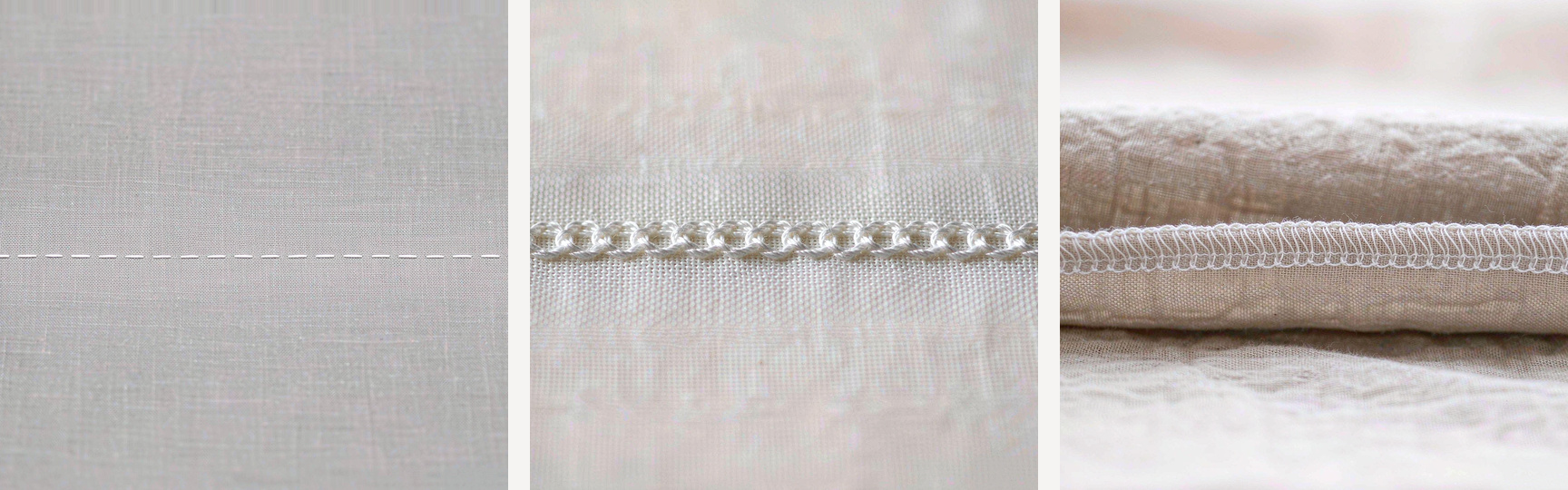
A lockstitch is formed by two threads — a needle thread and a bobbin thread — interlocking inside the fabric. A rotary hook catches the needle thread loop, carries it around the bobbin, and interlocks the two threads. The result looks identical on both sides of the material.
Strengths
- Reversible appearance. Same stitch on face and back
- Does not run back. A broken lockstitch thread does not unravel the whole seam. Coats still rates 301 as the most secure of the common stitch types
- Lowest thread consumption of the three categories
- Excellent seam security on woven fabrics
Limitations
- Very low elongation. This is the defining constraint. Where the fabric stretches, a 301 lockstitch does not — and the thread breaks
- Bobbin changes. Under-thread supply is finite, which costs productive time
Industrial applications. The lockstitch is the workhorse of woven garment construction: side seams, topstitching, pocket attachment, plackets, and hemming.
For heavy denim bottom hemming, Juki’s DLN-6390 cylinder-bed lockstitch is a useful reference: a 35 mm needle bar stroke for increased needle penetration and adaptability to heavy-weight material, which Juki states frees the operation of "stitch gathering, stitch skipping, and needle breakage." It runs at 5,000 sti/min with 14 mm of presser foot lift and a 1.7-fold hook.
DOIT machines in this class: the DT C10-D4 direct-drive computerized lockstitch with stepper motor (5,000 spm, 550 W) for precision denim construction, and the DT 165-02 placket machine for smooth, flat finishes that survive daily wear.
3. What Is a Chainstitch and When Should You Use It?
A chainstitch interloops one or more needle threads with looper threads on the underside of the fabric. There is no bobbin — the looper thread feeds directly from the thread stand, which means continuous production without bobbin changes.
Strengths
- High elongation. A two-thread chainstitch (Type 401) stretches far more than a lockstitch — industry figures commonly put 401 around 30% seam elongation against well under 5% for 301
- Lower pucker. Coats notes 401 delivers lower seam pucker where the cause is structural jamming
- No bobbin, which raises productive time
- Good seam strength, particularly with multiple needles
Limitations
- Prone to runback. If the looper thread tail is not secured, a 401 seam can unravel. Chainstitch ends are back-tacked or over-sewn for this reason
- Higher thread consumption — roughly two to three times a lockstitch
- Not reversible in appearance
Industrial applications. Knitwear and stretch seams, waistbands, decorative stitching, and — significantly for denim — safety stitching, where an overedge and a double chainstitch are combined (see Section 4).
DOIT machines in this class: the DT 254 belt loop machine for uniform strength and durability, and the DT 1508P-D direct-drive 4-needle double chainstitch machine, both built for denim duty.
4. What Is an Overlock Stitch and Why Is It Essential?
The overlock stitch (overedge, serging) sews over the edge of one or two plies, trimming and covering the edge in the same pass.
Strengths
- Cuts and sews simultaneously — one operation instead of two
- Highest extensibility of the three. Arrow Threads describes the three-thread overedge (504) as providing the maximum attainable extensibility, with seams able to extend well beyond 100% under favourable construction
- Clean, durable edge that will not fray
- 3, 4 and 5-thread configurations for different duty levels
The 5-thread safety stitch combines a 3-thread overedge with a 2-thread chainstitch. It is the configuration used for woven workwear, chinos, and jeans where both edge finishing and seam strength are required in one pass.
Two roles, and it matters which one you need
- On knits, overlock is a primary structural seam — this is how jersey garments are assembled. A 301 lockstitch cannot substitute here
- On wovens, it is edge finishing — it does not replace a lockstitch for structural seams
Limitations
- Highest thread consumption of the three
- Ends must still be secured. Overedge seams resist runback better than a chainstitch, but a loose tail on a 3-thread overlock will still come undone
DOIT machines in this class: the DT 900-4AT direct-drive overlock with electronic auto trimmer and stepper motor, specified for thin, medium and thick fabrics across T-shirts, shirts, jeans, trousers and knitwear.