



Direct Drive vs Clutch Motor Sewing Machine: Which Saves More in 12 Months?
Direct Drive vs Clutch Motor Sewing Machine: Which Saves More in 12 Months?
1. First, a Correction That Will Save You Money
Most articles with this title compare the wrong two things — including, until now, this one.
The saving does not come from direct drive. It comes from the servo motor.
These are two separate decisions:
- Clutch motor vs servo motor — this is the motor question. It determines your power bill, your noise level, and how precisely the operator controls speed.
- Belt vs direct drive — this is the transmission question. It determines how much maintenance you do and how torque is delivered to the needle bar.
Almost everything the internet credits to “direct drive” is actually a property of the servo motor. And that distinction matters commercially, because it means there are three options on the table, not two:
|
Option |
What you buy |
What you get |
|
1. Keep the clutch motor |
Nothing |
No energy saving. Lowest capital cost. |
|
2. Belt-driven servo retrofit |
Servo motor + bracket, fitted to your existing machine head (~$100–250 per machine) |
Essentially all of the energy saving. You keep your existing heads. |
|
3. New direct-drive servo machine |
Complete machine, motor integrated into the head ($200–500 premium over a comparable clutch machine) |
The energy saving plus no external belt, no clutch/brake assembly, and tighter speed control. |
Option 2 is the one most articles leave out, and for a factory with 50 working machines it is usually the fastest payback available: you buy the saving without buying 50 new machines.
The rest of this article quantifies the saving, then tells you honestly how long each option takes to pay for itself.
2. How Clutch Motors Waste Energy
The mechanism
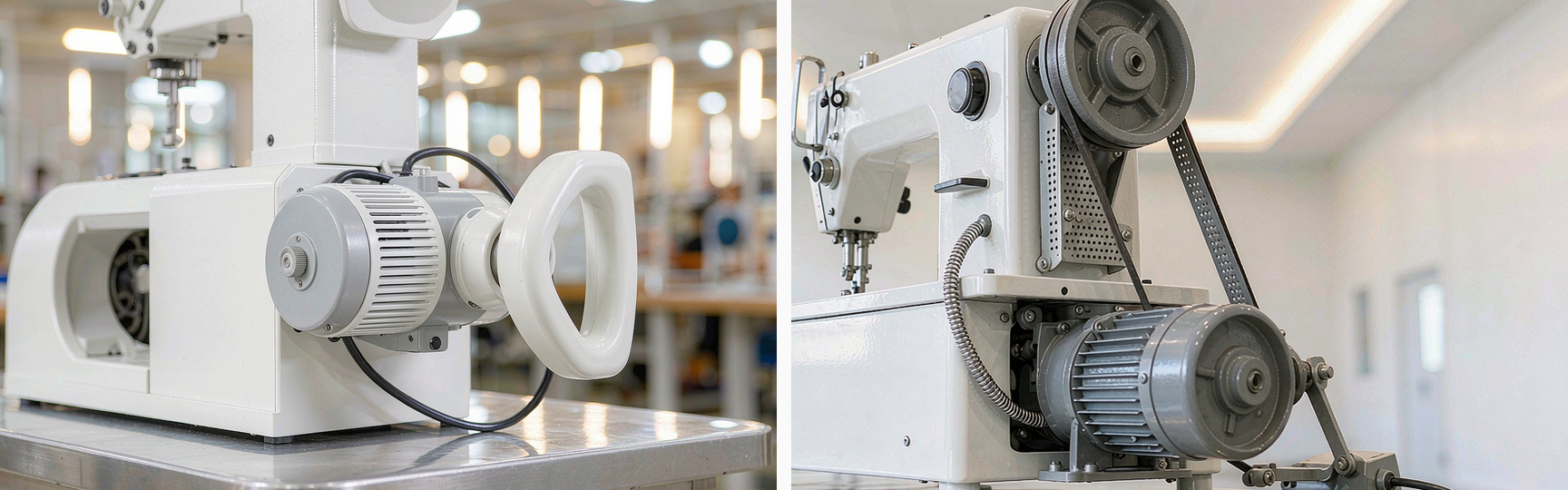
A traditional clutch motor assembly has three parts: a three-phase induction motor, a clutch, and a belt pulley. Once switched on and up to speed, the motor keeps rotating at rated speed whether or not the pedal is pressed.
That is the whole problem. The needle is still. The motor is not.
In real garment production the needle is actually sewing for roughly one-third of a shift — operators spend the rest of the time positioning, trimming, rearranging bundles, and handling fabric. A published breakdown from Pepkor’s sustainability programme puts actual needle time at about one-third of the operator’s day. On heavy denim and thick assemblies, that fraction is usually lower, not higher, because repositioning takes longer.
So a clutch motor draws close to its rated wattage for 100% of the time the machine is switched on, while doing useful work for maybe 30% of it.
One clarification that matters
You will also see clutch motors described as having an efficiency below 75%. That is true for small induction motors of this size, but it is a separate and much smaller effect. Motor efficiency describes how much of the electricity drawn is converted into mechanical work. Idle running describes electricity drawn while doing no work at all. Do not add the two together — idle running is the dominant loss, by a wide margin.
3. How Servo Motors Work
A servo motor runs only when the pedal is pressed, and its speed follows the pedal continuously instead of sitting at one fixed speed. When the machine is idle, a modern servo draws roughly 1 watt in standby.
|
Metric |
Clutch motor |
Servo motor |
|
Runs when pedal is released |
Yes, at rated speed |
No |
|
Standby draw |
Near rated wattage (~450 W) |
~1 W |
|
Speed control |
Fixed; pedal only engages the clutch |
Variable across the full range |
|
External belt and clutch/brake assembly |
Required |
Not required on direct-drive units |
What published data actually shows
Field measurements and supplier-reported retrofit programmes cluster in a consistent band:
- 65–70% reduction in overall energy consumption (Pepkor sustainability reporting)
- 60–70% reduction, with clutch motors rated at 400–550 W and servo standby around 1 W (industrial sewing machine retailers’ technical notes)
- Sewing machines account for up to 70% of a garment factory’s total electricity use, which is why this single component moves the whole bill
Treat 60–70% as your planning number. You will see figures above 80% quoted, including in the model below; those come from models that assume a clutch motor draws its full rated wattage every second it is switched on, which an unloaded induction motor does not in practice.
4. The 12-Month Energy Model — With the Assumptions Exposed
Here is the model, with every input stated so you can substitute your own.
Assumptions: one machine, 8 hours per day, 300 days per year (2,400 hours), electricity at $0.12/kWh, needle active 30% of powered time (720 hours).
Clutch motor (450 W rated):
|
Parameter |
Value |
|
Annual consumption |
2,400 h × 0.45 kW = 1,080 kWh |
|
Annual cost |
1,080 × |
Servo motor (250 W active, ~1 W standby):
|
Parameter |
Value |
|
Active consumption |
720 h × 0.25 kW = 180 kWh |
|
Standby consumption |
1,680 h × 0.001 kW = 1.68 kWh |
|
Annual consumption |
181.68 kWh |
|
Annual cost |
181.68 × |
Savings per machine:
|
Metric |
Clutch |
Servo |
Saving |
|
Annual electricity |
1,080 kWh |
181.68 kWh |
898.32 kWh |
|
Annual cost |
$129.60 |
$21.80 |
$107.80 |
For 50 machines: 44,916 kWh and $5,390 per year.
Read this before you use the 83% figure
The saving above is 83.2% — higher than every field measurement cited in section 3. The model gets there because it charges the clutch motor its full 450 W for all 2,400 hours. In reality an unloaded induction motor draws well below its rated current, so the true figure sits lower — which is why the published band is 60–70%.
Use 60–70% for budgeting. Treat 83% as a ceiling, not a forecast. At a more conservative 65%, the per-machine saving is about $84 a year rather than $108, and 50 machines save roughly $4,200 rather than $5,390. The conclusion does not change; the number does.
5. What Retrofit Programmes Actually Report
Large-scale retrofit programmes in Bangladesh’s ready-made garment sector — including the IFC-led Partnership for Cleaner Textile (PaCT), which has worked with more than 450 factories — have published energy and emissions reductions from replacing clutch motors with servo motors. Directionally, those programmes report the same thing the physics predicts: substantial reductions in electricity use per machine, with payback periods short enough that financing has not been the binding constraint.
We have not reproduced a specific factory’s figures here, because we could not verify them to a primary source. If you are building a business case, ask your motor supplier for a named reference you can call, and check it against your own tariff and your own needle-time figure. A verified local reference is worth more than a round number from an article.
6. Beyond Energy: Maintenance and Productivity
Maintenance
A clutch assembly has wear parts: the belt, the clutch and brake linings, and the pulley. A direct-drive unit removes the external belt and the clutch/brake assembly entirely, which deletes the most common service items on a sewing head.
|
Item |
Clutch motor (annual) |
Direct drive (annual) |
|
Belt replacement |
$50–100 |
$0 |
|
Clutch adjustment / repair |
$100–200 |
$0 |
|
Motor cleaning |
$50–100 |
Minimal |
|
Total |
$200–400 |
$0–50 |
In fairness: direct drive is not maintenance-free, and it is not strictly lower-risk. The motor sits inside the machine head, where it runs hotter than an externally mounted belt-driven motor, and when a position sensor or control board fails, the repair costs more than a belt. What direct drive removes is frequency of routine service, not all service risk. Plan on the low end of the range above, not on zero.
Productivity — the number that decides the whole argument
Servo motors give operators variable speed, instant start/stop, and consistent needle positioning. Published productivity gains run from 15% to 20% on comparable operations.
Here is the arithmetic the way it is usually presented, and then what it actually assumes:
500 garments/day ×
2 profit × 15% gain × 300 days = **45,000** additional annual profit
Two things to understand before you use it:
- **That $45,000 is a factory-level figure** — 500 garments a day is whole-factory output. Per machine across 50 machines it works out to $900 each ($45,000 ÷ 50), and that division is doing real work.
- A 15% productivity gain is not automatically a 15% profit gain. The extra garments have to be sellable at the same margin, and changing motors does not raise output 15% on a line where cutting, finishing, or a bottleneck operation sets the pace. It raises output at the machines you changed.
Treat productivity as the upside case, not the baseline.
Total 12-month saving per machine
|
Category |
Clutch |
Servo / direct drive |
Saving |
|
Energy |
$129.60 |
$21.80 |
$107.80 |
|
Maintenance (midpoint) |
$300 |
$25 |
$275 |
|
Productivity (upside case) |
Baseline |
+15% |
$900 |
|
Total |
$1,282 |
7. ROI: Three Honest Payback Numbers
The payback depends entirely on which of those three lines you are willing to count. Against a premium of $200–500 per machine:
|
If you count |
Annual saving |
Payback |
|
Energy only |
$107.80 |
1.9 – 4.6 years |
|
Energy + maintenance |
$382.80 |
6 – 16 months |
|
Energy + maintenance + productivity |
$1,282 |
2 – 5 months |
That first row is the one most articles skip. On electricity alone, a servo motor takes roughly two to four years to pay for itself — which is exactly what the trade literature says (“the cost of a servo motor can be recovered within 2–3 years by saving money on electricity alone”). Anyone who tells you the power bill alone pays it back in months is either using a much higher tariff than $0.12/kWh or counting something else.
The 2–5 month figure is real, but it is 83% driven by the productivity line. If your line is capacity-constrained and that gain never materialises, your payback is the middle row.
Why the belt-driven servo retrofit deserves a look
If your machines are otherwise healthy, ~$100–250 per machine buys the energy saving and most of the control benefit. You keep the heads, the operators keep their machines, and the payback on the energy line alone improves by roughly half compared with a full machine replacement.
Factory-level view — stated properly
For 50 machines, using the same three rows:
|
Line item |
50 machines |
|
Energy saving |
|
|
Maintenance saving |
$13,750 per year (at $275/machine) |
|
Capital cost — servo retrofit |
$5,000 – $12,500 |
|
Capital cost — new direct-drive machines |
$10,000 – $25,000 |
The clean comparison is saving against capital cost. On energy plus maintenance alone ($19,140/year), a $5,000–12,500 retrofit pays back in 3–8 months; a $10,000–25,000 fleet replacement pays back in 6–16 months. Both are good investments. Neither requires you to assume a productivity gain you cannot yet prove.
8. Why Clutch Motors Are Still Being Sold
Worth understanding before you commit, because it explains what you are trading away:
- They are cheap — a fraction of a servo motor’s price.
- They are field-repairable — a belt and a clutch can be replaced with hand tools and generic parts, in-house, in minutes.
- They tolerate bad power — voltage fluctuation and phase imbalance, common in some sourcing markets, kill servo control boards faster than they kill induction motors.
- Servo repair needs a technician. If you do not have one, or cannot get boards quickly, downtime cost can exceed the energy saving.
None of this makes clutch motors the right choice. It explains why the decision is not as one-sided as the brochures suggest, and why the sensible version of this upgrade is usually retrofit the machines you run hardest, and specify servo on everything you buy new.
9. DOIT Group’s Direct-Drive Lineup
DOIT Group builds industrial sewing machines with direct-drive servo motors, specified for denim and heavy-material production.
|
Machine |
Application |
Key feature |
|
DT 254 |
Belt loops |
Uniform strength and durability |
|
DT 165-02 |
Placket |
Smooth, flat finish |
|
DT 3020TD |
Automatic pocket attaching |
Symmetrical shaping, clean curves |
|
DT 63900 |
Computerized hemming |
Consistent stitch quality |
|
DT C10-D4 |
Computerized lockstitch |
5,000 sti/min, direct-drive servo |
|
DT 900-4AT |
4-thread overlock |
Auto trimmer |
What sits behind the running costs discussed above:
- Direct-drive servo motors draw power only when the pedal is pressed, with roughly 1 W standby
- All-metal construction for durability across continuous shifts
- Automatic lubrication, which removes the most frequent routine service task
- 135×17 (DP×17) needle system on DOIT lockstitch machines — the most widely stocked industrial needle system, so consumables are easy to source locally. (Overlock and specialty units use their own needle systems; confirm per model.)
- ISO 9001 certified manufacturing, with CE marking on applicable models
- 1-year warranty on machine parts, 2-year warranty on the motor
- Lifetime after-sales support
10. The Bottom Line
Which saves more in 12 months? The servo motor, clearly — with the honesty about how it saves.
- **Energy:
107.80 per machine per year** in this model (~5,390 for 50 machines). Budget on 60–70% rather than the model’s 83%.
- Maintenance: roughly $275 per machine per year, from deleting the belt and clutch assembly.
- Productivity: 15–20% on the operations you convert — real, but an upside case rather than a guarantee.
- Payback: 2–4 years on energy alone; 6–16 months including maintenance; 2–5 months if productivity lands.
- The option most buyers miss: a belt-driven servo retrofit at $100–250 per machine captures most of the saving without replacing a single machine.
DOIT Group manufactures industrial sewing machines with direct-drive servo motors built for denim and heavy-material work — all-metal construction, automatic lubrication, standardised consumables, and ISO 9001 certified manufacturing with CE marking on applicable models.
Ready to model this against your own tariff and shift pattern? Send us your machine count, hours, and kWh rate and we will run the numbers on your actual data — not ours.
📩 Email: sales6@chinadoit.cn
🌐 Website: denimsewing.com